Taking Moving Grief offline: our first Transnational Partner Meeting in Spain
For months, the Moving Grief consortium has been working together across Finland, Spain and Greece. Monthly online meetings, research in three countries, interviews, course development and preparations for our immersive training have all happened largely through our screens.
At the beginning of October, we finally brought that work – and the people behind it – together in Cantabria, Spain.
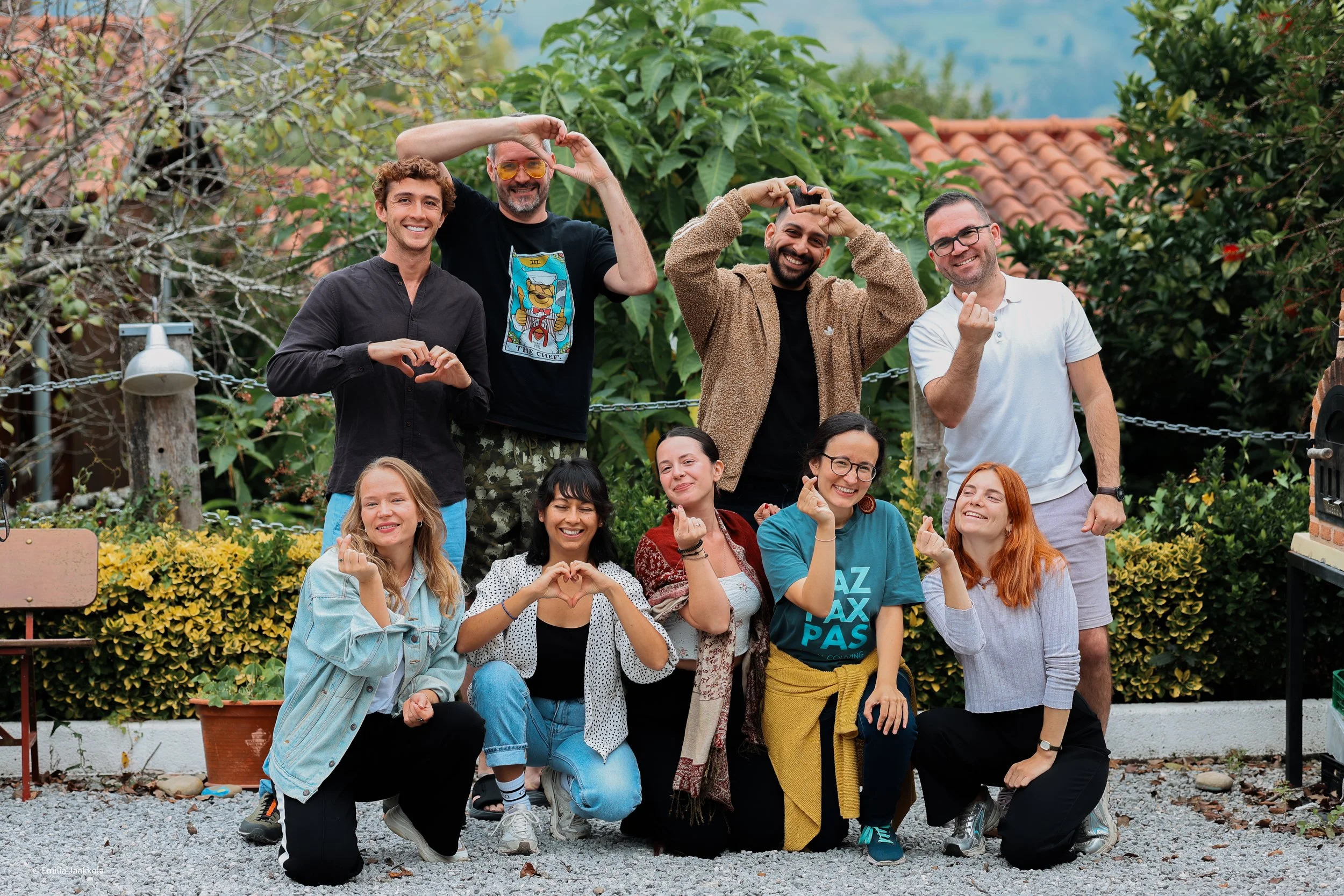
From 1–3 October, representatives from Taida, Diakonissalaitos, Roes Cooperativa and The Social Circle met at PAS Rural Coliving for the project’s Transnational Partner Meeting (TPM).
The meeting gave us time to look at how far the project has come, make decisions about the next phases and prepare for the Moving Grief immersive training starting immediately afterwards. But perhaps the most valuable part was getting outside our own project and seeing the realities behind the topic we are working with.
Starting with the reality of migrant support
Our first day took us to Santander to visit 14 Kilómetros, a local non-profit supporting migrants with social and labour integration.
Founder and coordinator Pilar Bezanilla and volunteer Azucena introduced us to their work and some of the everyday realities faced by the people they support. The organisation focuses heavily on immediate, practical needs: housing, food, language and navigating integration. Language barriers are a constant challenge. When emotional or mental health needs emerge, people are referred to specialized services rather than supported directly by the organization.
For a project focused specifically on the emotional impact of migration, this gave us a lot to think about.
After the visit, Camilo Russi facilitated a reflection with the consortium around a simple question: what does this reality mean for the resources we are creating?
Several things became clearer.
The tools we develop cannot assume that emotional wellbeing is the first concern of someone who has just migrated. Housing, food, work, legal processes and learning a new language may quite understandably come first.
Language also matters when designing support. A useful tool needs to be simple enough to understand and facilitate even when the youth worker and young person do not share a strong common language.
And youth workers don't need to become therapists. Sometimes their role is to recognise what may be happening, create space for it and know where someone can be referred when more specialised support is needed.
These may sound like simple observations, but they matter when moving from an idea about migratory grief to tools that people can actually use.
From an online course to practical tools
Back at PAS Rural Coliving, the consortium turned its attention to the different pieces of Moving Grief.
One of the biggest is our upcoming online course on migratory grief. The course brings together the research and interviews carried out in the partner countries with expert knowledge from Camilo Russi, giving youth workers a foundation for recognising migratory grief and responding to it without stepping into the role of a therapist.
During the TPM, we reviewed its progress and planned the next stages of testing, editing, translation and launch.
We also worked on the next part of the project: turning knowledge into things youth workers can actually use.
The consortium discussed the practical toolkit and the community that will eventually connect youth workers interested in grief-aware practice across countries. These resources will continue to develop based on what we learn from youth workers themselves.
And then came the backpacks, rocks and flipcharts
The timing of the TPM was intentional. As soon as the partner meeting finished, the Moving Grief immersive training was about to begin.
So part of our second day was very practical: preparing flipcharts, name tags, welcome postcards, post-its and the slightly less conventional collection of wood, rocks and backpacks needed for the experiential activities ahead.
The immersive training would be the first opportunity to bring youth workers from the partner countries into the process together: exploring migratory grief, testing what we have created so far and helping us shape the practical tools that will come next.
After months of developing Moving Grief online, the days in Cantabria marked an important shift.
The research is becoming a course. The course is becoming practical tools. And those tools are now being tested against the realities of the people who will eventually use them.
Most importantly, Moving Grief is moving from something developed for youth workers towards something developed with them.
And that is exactly where we want the next phase of the project to go.