
AI Compass: Nature is the true north
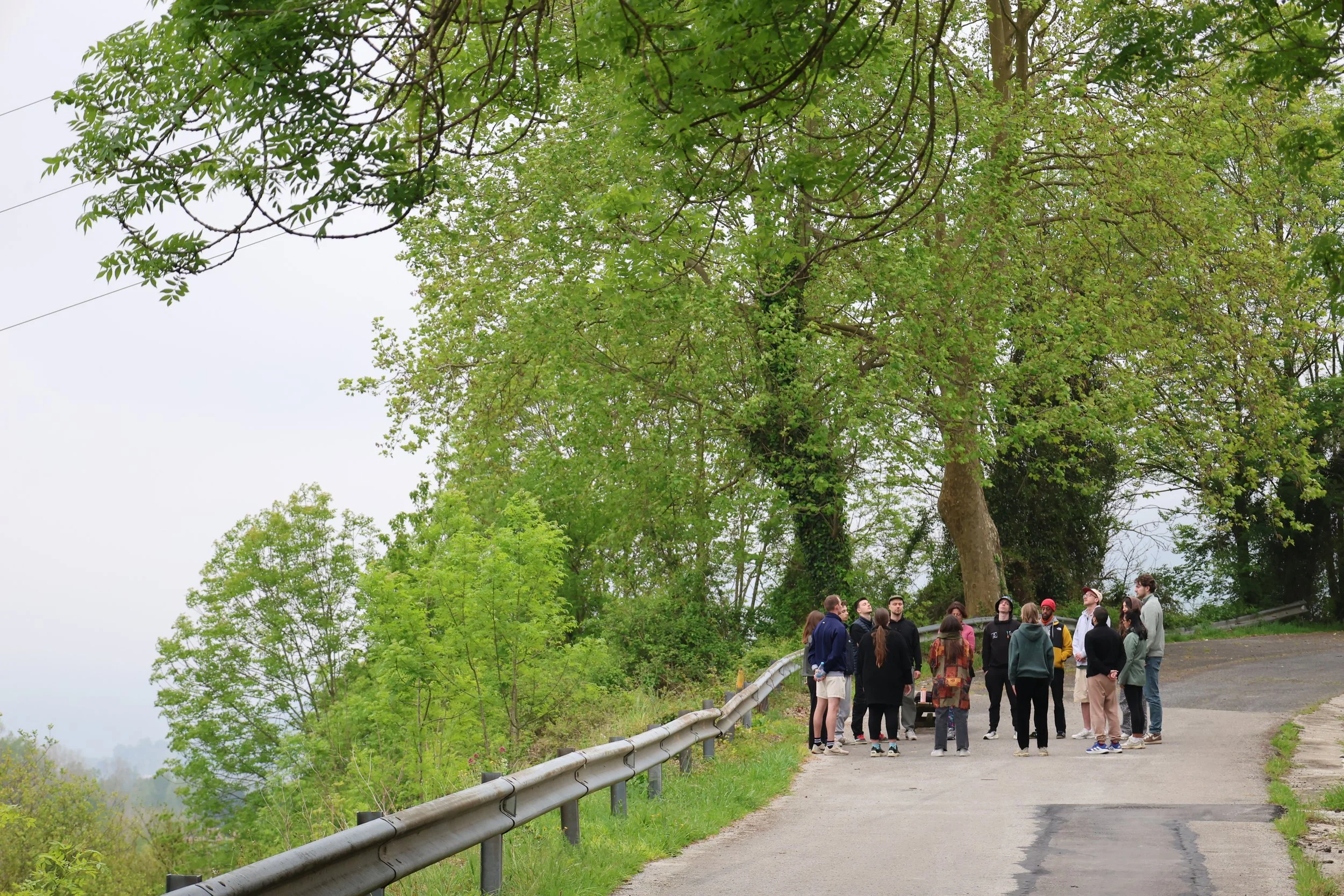
A cowbell is, probably, the last thing one expects to hear as background noise at an intensive artificial intelligence course. They belong to such different worlds that one might wonder whether a coliving space in rural Cantabria — Spain — , amid brilliant green pastures and misty mountains, is the right place to invest five days of one’s life in training on the technology set to govern the modern world. The lead trainer, Gera Castro, nods and smiles. A molecular biologist before becoming a data and AI ethics expert, he recognises the doubt on the faces of the eighteen participants from eight European youth organisations who have joined the first edition of AI Compass at Pas Rural Coliving. He trusts they will come to understand why there is no better place than this to grasp what AI really is.
Today is the fourth day, the penultimate of the programme. Participants are working in pairs or small groups. They have spent three days in workshops where they drew mind maps with markers, walked in silence through parks and country paths, and sketched each other’s faces in light, energising sessions. They also sat through weightier sessions where Gera walked them through the history and basic principles of AI, and invited trainer Wakanyi Macharia-Hoffman introduced the philosophy that underpins it. They have traced the arc from Alan Turing to Sam Altman; glimpsed what Bantu wisdom might offer the Silicon Valley mindset.
Now it is time to bring it all together and finish their prototypes: tomorrow they present to their peers how they have decided to apply AI to the work of their organisations.
Daria Ghilia finishes a task on her laptop before telling us about hers. She is president of Guttenberg Romania, an association dedicated to the personal development of German-speaking students in the country. She arrived at AI Compass — a project by The Social Circle, funded by the Erasmus+ programme — already convinced of AI’s power, having used it to analyse dozens of surveys from participants at her annual summer camp and realise that they were not being offered what they needed. «It helped us change our approach. Our users want us to help them make money, not theatre classes like we used to run», she explains.
«My prototype is an app that offers career guidance to students aged 16 to 18, based on trends from labour market reports in Romania, Europe, and the rest of the world», she says. «It could help hundreds of people in my country», she adds, excited, the next idea already clamouring for attention before she has finished laying out the previous one.
She turns back to her laptop. Next to it sits the magnolia cone she gathered for the second-day exercise, a session in which Gera asked everyone to go out into the fields and find examples of natural intelligence. «I chose this fruit because it protects the seeds until they are ready to come out», she says again, quickly, perhaps not yet fully aware of the connection between the app for students she is building and the woody pod she picked up from the garden.
Emilia Grawoska knew nothing about AI before this training, but the shark-mouth-shaped hood this soft-skills trainer is wearing suggests that novelty does not frighten her. «Three days ago I didn’t know what the Copilot icon in Office even was», she says, laughing. Tomorrow she is leaving «with a content plan for social media» built with ChatGPT. The day after that, she will present it to the team she leads at Q Zmianom, a Warsaw-based association focused on creating safe spaces where families dealing with financial hardship, addiction, or similar situations can find their way forward.
«The problem is the soft-skills gap in young people», she says, recalling the prompt Wakanyi has thrown at them throughout the week: What problem do you want to solve in the world? «These days, younger kids cannot hold eye contact for more than five seconds; they look away. They lack the basics needed to communicate and cooperate», she says, serious. A devotee of board games and their power to connect people, Emilia has spent years using gamification in her work, but far more young people need these interventions than her association can reach. «I need to train teachers to use our games in schools», she explains, «and now I know that AI can help me build a platform to do that».
Emilia shows the yellow flower she photographed growing between the stones of a wall for Gera’s natural intelligence exercise. She seems fully aware of the link between her choice and her work in Warsaw. «Our motto is that everyone can move forward when the soil is right», she says, smiling.
Hamze Ahmed, a 29-year-old psychiatric nurse from Finland, chose a dry leaf. He likes the idea of something that falls from a tree and at the same time nourishes its next iteration — the recurrence of the natural cycle. Perhaps because the AI tool for social workers he came here to finish works in a similar way, constantly checking the content on which it was trained in order to provide responses to users. But he talks about the leaf without much conviction. Perhaps because he made that choice on the second day, before Wakanyi’s talk — she is a speaker and researcher in ethical AI and indigenous intelligence applied to technology — ; before knowing what he would learn from it.
«It surprised me at first that the training wasn’t as technical as I expected», he admits, his eyes fixed on a sheet of paper, an A3, on which he has been working all afternoon. It reads «Principles», followed by ten points. «But here I found a solution to the main problem my project had», he explains. Wakanyi’s talk, incorporated into AI Compass as the first activity of the Schumacher College España programme, was an exposition of how humanism completes the way we understand AI. «Learning about Ubuntu philosophy put me on the right track», says this young entrepreneur.
Hakunamata is the name of his app, designed to streamline the child protection work carried out by social workers. The AI analyses the situations they encounter and recommends courses of action based on more than 700 case files on which it was trained. This means the worker does not have to consult reports and data that delay decisions which, in this field, are critical. Hakunamata is an app that has seen almost everything and knows what to do with it.
And that «almost» is the problem. Because if a child presents circumstances with no precedent in its training data, the machine’s logic can make a fatal triage error. Until the second day of AI Compass, Hamze’s AI was guided by professional custom. Since its developer discovered that he can translate ethical principles into technical guidelines that govern his app’s decisions, it no longer is.
He points to the sheet. «This list covers situations that are always a priority in child protection, regardless of whether they appear in the case history or not», the young man explains. «They are value-based guardrails — a constitution to guide the AI’s decisions. This solves the false positives problem I had», he adds, from the coliving’s coworking space.
Hamze’s is the last presentation. Gera smiles. His eyes light up. AI Compass closes with a dozen prototypes that embed humanist principles and natural logics into their design. He has managed to make the participants understand that artificial intelligence can be a tool with no limits and no owner — benign and sustainable. «The artificial intelligence I believe in is a technology that can become a system that organises our electricity grids, our transport networks, the resources of a community. Just as the fungal network connects everything that grows from below ground», Gera will say in one of the workshops. A digital spirit that regulates our presence on the planet with the reliability with which the parasympathetic system governs our breathing.
The raw connection with natural life over these five days has completed the participants’ understanding of AI. They are going home with photosynthesis and composting as valid models on which to base technological solutions, with ethics and community as key design elements rather than decoration or marketing. Knowing that AI does not necessarily mean rubble, extinction, and colonies on Mars. Suspecting that those fears may, in fact, be a naive vision of the future. Because in the end — which has more force to prevail, technology or nature?
By Andrés Valdés, originally published in PAS Rural Coliving’s blog.